To compare IPTV providers without getting burned, make every seller answer seven questions in writing before any money moves: what is the total in Canadian dollars, what is the refund window and when does it start, does it renew automatically, who handles payment and how, who do I talk to if it breaks, will you check my channels first, and how long has this business existed. A seller who is vague on any one of them is telling you something. This guide shows you how to ask, how to score the answers, and what the honest answers look like, ours included.
Why people get burned, in the order it usually happens
The same few things go wrong again and again, and most of them are visible before payment if you know where to look.
- The cheap lifetime deal. A “lifetime” plan for a small one-off payment has to be funded by somebody. Either the seller disappears when the money runs out, or the service quietly degrades. Streaming costs real money every month.
- The seller who vanishes. Many IPTV sellers resell someone else’s service and have no recourse if the supplier fails. When the supplier goes dark, so does the reseller, and the customer’s prepaid months go with them.
- Payment in a form that cannot be reversed. Gift cards, crypto and some transfer methods leave no way back if the seller stops answering.
- The fee that appears at the last step. Advertised price, then extras at checkout. The Competition Bureau treats this “drip pricing” as a serious problem; it fined a Canadian subscription company CA$3.3 million for leaving a mandatory fee out of advertised prices, as described in its announcement. The case was about satellite radio, not IPTV, but the principle is the one you should apply to any subscription.
- The auto-renewal nobody mentioned. The first charge is small and the second arrives unannounced.
- The channel that is not there. A seller promises a team, a league or a specific channel, and after payment it is missing or unreliable.
None of these are exotic. They all come down to the same thing: the seller held back a fact until after you paid.
The seven questions, with good and bad answers
| Question | A reassuring answer | A worrying answer |
|---|---|---|
| What is the all-in price in CAD? | One number, in dollars, before you commit | “Depends”, or a price in another currency, or fees later |
| What is the refund window, and when does it start? | A number of days from a stated date | “Case by case” or no policy |
| Does it renew by itself? | No, renewal is manual | “You can cancel anytime” with no explanation |
| How do I pay, and who sees my details? | A person walks you through it and never asks for card numbers in chat | Card number requested by message, gift cards, crypto only |
| Who do I contact when it breaks? | A named channel with a real reply time and your language | A form with no follow-up |
| Will you check my channels before I pay? | Yes, and honest about what they cannot confirm | “Everything is included” |
| How long has the business operated? | A plain answer you can sanity-check | Evasion, or a brand-new name every season |
You do not need to be confrontational. Send the seven questions in one message and read what comes back. The tone of the answer matters as much as the content. A seller who treats questions as normal is a different animal from one who pushes you to decide today.
How My IPTV Canada answers them
We would rather you test us than trust us. Here are our published terms, in the same order.
- Price: in Canadian dollars. One screen is CA$19 for one month, CA$29 for 3, CA$49 for 6 and CA$79 for 12; two to four screens go up to CA$199 for four screens on 12 months. Prices are on the pricing page and are held until January 15, 2027.
- Refund: a 60-day money-back guarantee for eligible new paid subscriptions, starting at first paid activation, with no refund fee. Read the guarantee and the refund request page before you buy.
- Renewal: manual. We do not charge you automatically.
- Payment: checkout on the site asks for your name and email only. Payment is arranged with a person on WhatsApp, via Interac e-Transfer or other options we agree with you. We never ask for card details on the site.
- Support: 24/7 customer service on WhatsApp and email, in English and French. Details are on the contact page.
- Channels: we do not promise a specific channel, team or event in writing. Ask, and we will check before you pay.
- History: we have been in business since 2017 and have 68,000+ subscribers.
An honest caution: Interac e-Transfer is fast and familiar but hard to reverse once it is sent. That is why the refund terms and the chat history matter, and why you should keep both.
A pre-payment test script you can copy
Send this to any seller. It takes two minutes and filters out most of the bad ones.
- “Please confirm the total price in Canadian dollars for [plan], with no extra fees.”
- “What is your refund policy, how many days, and from what date do they count?”
- “Does this renew automatically? If so, how do I stop it?”
- “How do I pay, and do you ever need my card number?”
- “Can you check [channel or event] before I buy?”
- “Who do I message if it stops working at 9 pm on a Saturday?”
Save the replies. If a seller changes the terms after payment, a saved message is your evidence. Keep screenshots of the price shown and the date.
Test the service properly, not politely
If a trial or short first term is available, do not test at 2 pm on a Tuesday. Test the way you will actually watch:
- Run a live channel for 30 minutes during the 7 to 10 pm window, when networks and servers are busiest.
- Switch channels ten times and note how long each takes. A few seconds is normal on a decent connection; long waits are not.
- If you have more than one TV, run two screens at once, since multi-screen behaviour is where weak setups break.
- Open the program guide and check that the times match your time zone. Our EPG explainer covers the fixes.
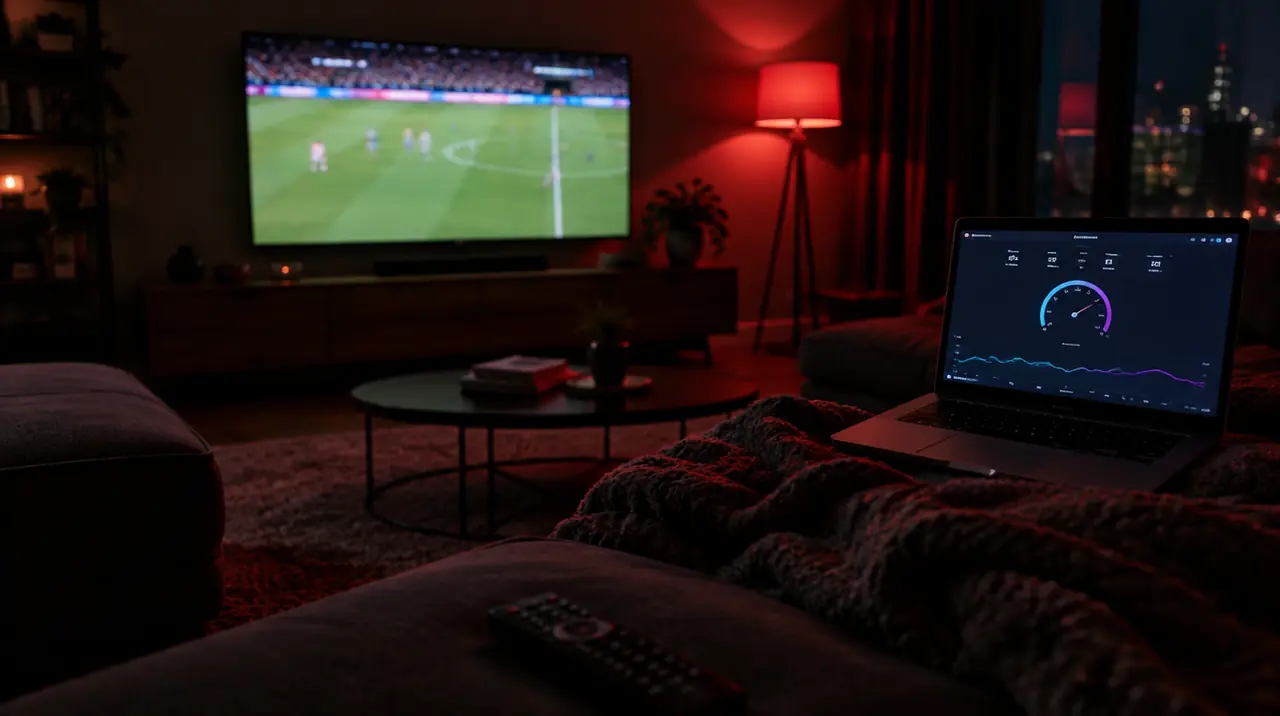
- Check your own side first. Run a speed test at the TV. If your Wi-Fi is the weak link, no provider will look good, so see how much speed IPTV needs.
We offer a free 24-hour trial by WhatsApp message, and the trial checklist shows how to use it well. A trial from any seller tells you about quality, but it tells you nothing about what happens after you pay, which is why the refund terms matter more.
Red flags you can spot without paying
- Review pages that all praise one seller. If a site “ranks” providers and links each to a signup, treat it as advertising. Be sceptical of any review that reads like a brochure, including ones on this site; test with your own questions.
- Prices that sit far below the rest of the market. If the rate for 12 months looks like a typo, ask who is paying for the difference.
- No contact route but a social media DM. Real businesses publish an email or phone route that survives a deleted account.
- Pressure. “Only today” and “last spots” are sales tactics, not facts.
- Total certainty. Claims such as “never buffers” or “every event included” cannot be true for every viewer on every connection. Buffering often starts at your end. Our buffering guide explains how to tell.
A worked example: two hypothetical quotes
Imagine you ask two sellers for a 12-month plan for two screens. Seller A answers in four minutes: CA$129 all-in, 60 days from first activation, manual renewal, payment arranged on chat with a person, support in French and English, and a promise to check your channel before you buy. Seller B replies with “CA$60 lifetime, 1000s of channels, pay now to lock the price”, sends a link to a page you cannot read, and goes quiet when you ask about refunds.
Score each out of seven. Seller A earns six or seven. Seller B earns zero or one, and the price alone should have told you. A 12 month plan that looks cheaper than the cheapest one-month rate repeated is not a bargain, it is a question mark. For reference, 12 months on two screens with us is CA$129, versus CA$348 for paying the CA$29 one-month price twelve times, a saving of about 63% on that basis. A price that deep below our own published rate still needs an explanation from the seller.
Real price differences exist, because sellers run on different cost structures. But price is one of seven questions, and it is the easiest one to win by cutting corners you cannot see.
If something does go wrong
If a seller stops responding after payment, take these steps in order. First, collect your messages, receipts and the date of payment. Second, ask once more in writing for the refund the terms promise. Third, if you paid through a financial institution, contact it quickly; options depend on the method used, and they close with time. Fourth, report the incident to the Canadian Anti-Fraud Centre, which collects reports and publishes warnings. Fifth, tell your household not to reuse the same password anywhere the seller saw it.
If the problem is only quality, not fraud, you have an easier road. Use the refund request process within the window, and expect to be asked for your payment date and a short description of the issue.
A note on legality
Legality depends on where the content comes from and how it is licensed, and it varies by channel and event. We do not give legal advice. Our explainer on whether IPTV is legal in Canada sets out the questions to ask. A seller who brushes the question off is a seller to avoid.
The short version
Score each seller out of seven using the table above. Anyone who scores five or more with clear written answers is worth a small first purchase. Anyone below four should be skipped, however good the price looks. And keep the terms you were quoted. For a broader view of how plans compare with cable, read cable versus IPTV costs.
Frequently asked questions
How can I tell if an IPTV provider is legit?
Ask for the all-in price in CAD, the refund window and its start date, how renewal works, how payment is handled and who answers support, all in writing. A legitimate seller answers plainly and will check your channels first. Vague answers or pressure to pay today are warning signs.
What are the biggest IPTV red flags?
No refund policy, prices far below the market, lifetime deals, card details requested in chat, payment only by gift card or crypto, and promises like never buffers or every event included. A seller reachable only by social media DM is also a risk.
Is it safe to pay an IPTV provider by e-Transfer?
Interac e-Transfer is quick, but hard to reverse once sent, so be sure of the seller first. Ask your questions, keep the messages and receipts, and only pay a seller that publishes refund terms. Never send card numbers by chat.
How long should I test an IPTV service before paying for a year?
Test during the busiest hours, 7 to 10 pm, for several evenings, including two screens at once if you plan to use them. Then start with a shorter term or rely on a refund window long enough to cover real use, such as 60 days.
Do IPTV providers renew automatically?
Some do, and you should ask before paying. Ours does not: renewal is manual and we do not charge you automatically. If a seller says you can cancel anytime but will not explain how, treat that as a risk.
Where do I report an IPTV scam in Canada?
Report it to the Canadian Anti-Fraud Centre, and contact your bank or payment provider quickly if money was sent. Keep every message, receipt and screenshot, because they help with any claim or report.
Sources
Your next step
Test the channels you actually watch.
Tell us your device, languages and preferred channels. We will help confirm availability and set up a free 24-hour trial. Read the plan and guarantee terms before paying.
Useful for someone else?
Share the guide without losing the context.